Have you ever looked up at the night sky and realized you can only see a handful of stars? For most of us, urban glare has completely erased the cosmos. It's no wonder that astrotourism is booming, with the market expected to hit $400 million by 2030.¹ People are actively seeking out the darkest corners of the planet to reconnect with the universe.
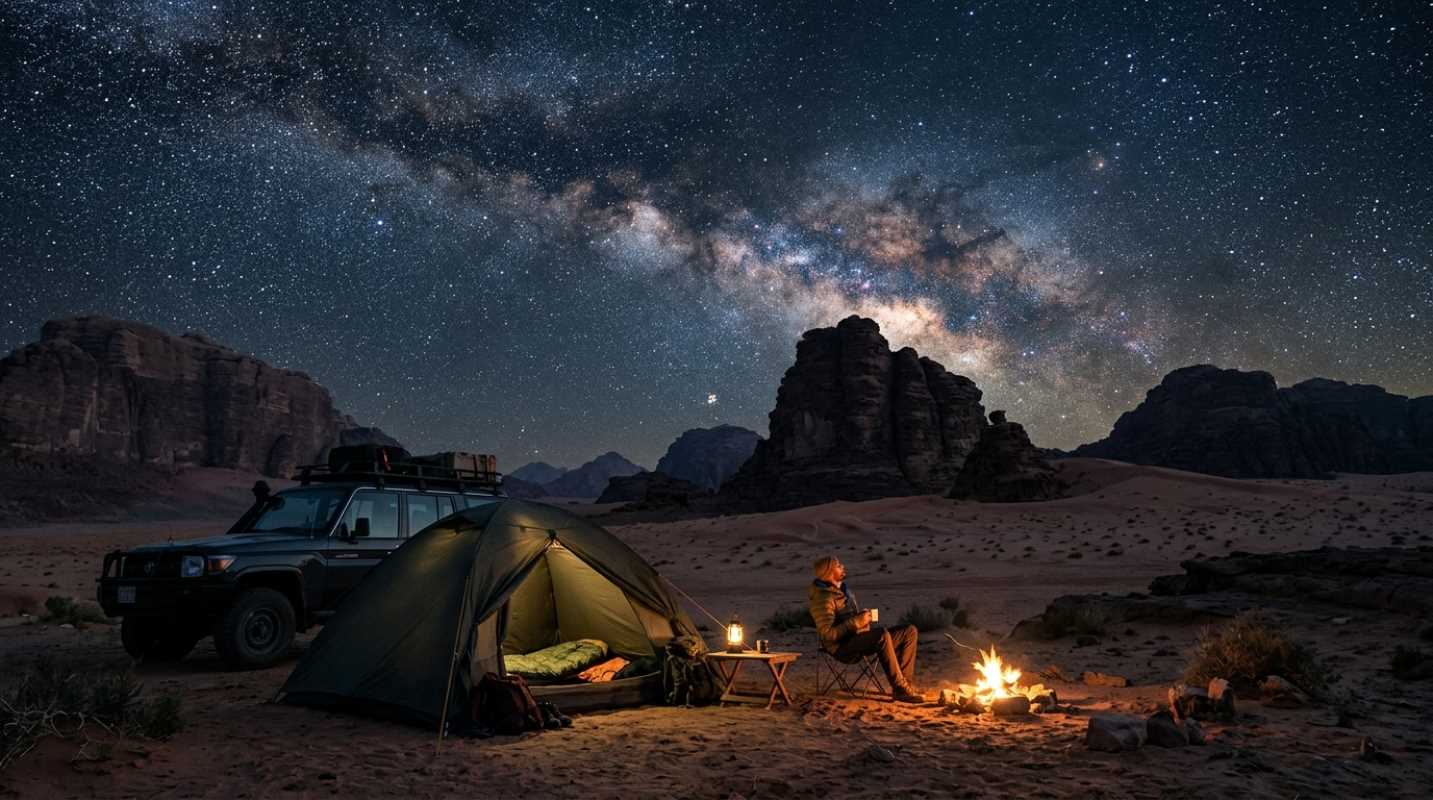
For stargazing, dry environments are the undisputed champions. Why? Because dry air lacks the moisture that traps light and blurs your view. High elevations and vast distances from cities mean you get a crystal-clear window into the galaxy. It's just you, a sleeping bag, and millions of stars overhead.
Wild camping in these arid regions takes the adventure to another level. Forget crowded campgrounds with noisy neighbors and RV generators. Out here, you get true off-grid living, deep silence, and a raw connection to the earth. If you're ready to trade your screen for the Milky Way, these dry areas are waiting.
Top-Tier Desert Destinations for Unmatched Dark Skies
Finding the perfect spot to pitch your tent under a blanket of stars requires some planning. Some of the best locations in the world offer designated dark sky protection, meaning local communities actively limit light pollution to keep the night sky pristine.
North American Dark Sky Havens
• Anza-Borrego Desert State Park (California): This massive park is a certified International Dark Sky Park. It's also the first designated Quiet Conservation Area in the U.S., protecting natural sounds alongside the dark skies.² You can enjoy free dispersed camping across most of its 600,000 acres. Popular spots include Blair Valley, Fish Creek, and Coyote Canyon. Just remember that ground fires are strictly banned, so you must bring a metal fire container.³
• Death Valley National Park (California and Nevada): Holding a Gold Tier rating, this park offers some of the darkest skies in North America. To protect the environment, the park has a mandatory permit system for its popular backcountry roadside corridors. Permits cost $10 per night via Recreation.gov and are released on a rolling six-month basis. You'll need a high-clearance four-wheel-drive vehicle to reach primitive spots like Echo Canyon or Greenwater Valley.
• Cosmic Campground (New Mexico): This is the first International Dark Sky Sanctuary in North America. It's specifically designed for astronomers, featuring permanent concrete telescope pads. The nearest major light source is over 40 miles away. The rules here are strict: no white lights are allowed after dark, meaning you've got to use red-light flashlights only.
International Stargazing Gems
• Atacama Desert (Chile): With its extreme altitude and near-zero humidity, this is widely considered the premier stargazing spot on Earth. True wild camping is possible, but you must be entirely self-sufficient. Be sure to avoid camping near active archaeological sites or protected reserves without local permits.
• NamibRand Nature Reserve (Namibia): This is Africa's first Gold Tier International Dark Sky Reserve. To protect the fragile environment, completely unrestricted wild camping is not allowed. Instead, you must book remote eco-campsites or private stargazing platforms where all lights are shielded to point downward.
Mastering the Art of Wild Camping Desert Style
Camping in arid regions is incredibly rewarding, but these environments are highly unforgiving. If you go unprepared, a dream trip can quickly turn into a survival situation. Mastering this style of camping requires the right gear, a deep respect for the environment, and strict safety habits.
Needed Gear and Preparation
• Water Scarcity: This is the golden rule of the desert. You must carry a minimum of one gallon (about four liters) of water per person, per day, for drinking and basic hygiene. Always pack an extra two to three gallons in your vehicle for emergencies. Never ration your water. If your supply drops to 50 percent, your trip is over and you must turn back immediately.
• Extreme Temperature Swings: Dry air cannot hold heat. A daytime high of 95 degrees Fahrenheit can easily plummet to 35 degrees or lower at night. Pack high-quality thermal base layers, a warm beanie, and a sleeping bag rated at least 10 degrees colder than the expected nighttime low.
• Flash Flood Awareness: Dry ground does not absorb water well. A storm occurring 25 miles away can send a massive wall of water rushing down a dry wash in minutes, even under clear blue skies. Never camp in a dry wash, arroyo, or canyon floor. Always pitch your tent on high ground. If you hear a low rumbling sound or see muddy water trickling down a dry bed, climb to high ground immediately.
• Wildlife Hazards: Rattlesnakes, scorpions, and spiders are highly active at night. Keep your tent zipped shut at all times. Never stick your hands or feet into rocky crevices without looking first, and always shake out your boots before putting them on in the morning.
Environmental Etiquette and BLM Rules
• The Red-Light Rule: White light ruins your night-adjusted vision, which takes up to 30 minutes to develop. Use red-light headlamps to preserve your vision and protect local nocturnal wildlife.
• Cryptobiotic Soil: Desert soils are held together by fragile, living crusts that take decades to recover if crushed. Never drive off designated roads, and try to walk only on established trails or sandy washes.
• BLM Dispersed Camping: On U.S. public Bureau of Land Management lands, you can camp in one spot for up to 14 days. After that, you must move your camp at least 25 miles away. Always camp at least 200 to 300 feet away from any natural water source so local wildlife can drink undisturbed.
How to Capture the Cosmos with Desert Stargazing Photography
Once you're out under a brilliant sky, you'll want to capture the magic. Taking great night sky photos is easier than you think, but it does require some specific camera settings and planning.
First, you need to set your camera to manual mode. Use a wide-angle lens with a wide-open aperture, ideally f/2.8 or lower, to let in as much light as possible. Set your ISO between 1600 and 6400 depending on how dark the sky is. To avoid blurry stars caused by the rotation of the Earth, use the "500 rule": divide 500 by the focal length of your lens to find the maximum number of seconds you can keep your shutter open.
Timing is everything. The best time for stargazing and photography is during the new moon phase, when the sky is at its darkest. If you want to capture the bright core of the Milky Way, timing depends on the season. In the Northern Hemisphere, the core is most visible from March to October, while the Southern Hemisphere offers incredible views for most of the year.
Don't rely on guesswork to find constellations. Use mobile apps like SkyGuide, Stellarium, or PhotoPills to track the movement of the stars and plan your shots before the sun even goes down. Just remember to turn your phone screen brightness all the way down and use a red filter to keep your eyes adjusted to the dark.
Pack Your Bags for the Ultimate Night Sky Journey
There's something deeply humbling about spending a night in the desert. Standing under a dome of stars, far from the noise of modern life, gives you a perspective that is hard to find anywhere else. It reminds us of our tiny place in a vast, beautiful universe.
Planning your own wild camping trip takes effort, but the reward is worth every bit of preparation. By packing plenty of water, respecting local regulations, and keeping safety in mind, you can experience the wilderness at its most spectacular.
So, what's stopping you? Grab your gear, check the moon phases, and head out into the quiet darkness. The stars are waiting.
Sources:
1. Morocco Astro Tours
https://moroccoastrotours.com/best-stargazing-destinations-for-astro-tourists/
2. The Anza-Borrego Foundation
https://theabf.org/our-work/key-initiatives/quiet-dark-park-initiatives/
3. California State Parks
https://www.parks.ca.gov/NewsRelease/783