Have you ever stood next to a crystal-clear mountain stream, throat dry, and wondered if it's safe to drink? It's a classic backcountry dilemma. The water looks pristine, but microscopic pathogens like Giardia or Cryptosporidium could be waiting to ruin your trip.
That's why your hydration setup is the most important gear choice you'll make. Getting sick in the wild isn't just uncomfortable, it's dangerous. Fortunately, heavy pump filters are a thing of the past. Today, you have access to ultralight, highly efficient tools that fit right in your pocket.
But with so many options on the market, how do you choose? It helps to understand the difference between a filter and a purifier. A standard filter blocks bacteria and protozoa, while a purifier goes a step further to neutralize tiny viruses. Let's break down the best compact options available in 2026 to help you find the perfect match.
The Must-Have Gear and the Top 5 Compact Tools
Choosing the right tool depends entirely on your hiking style. Some hikers want speed, while others prioritize durability. Here's a look at the top five compact filtration systems making waves on the trails.
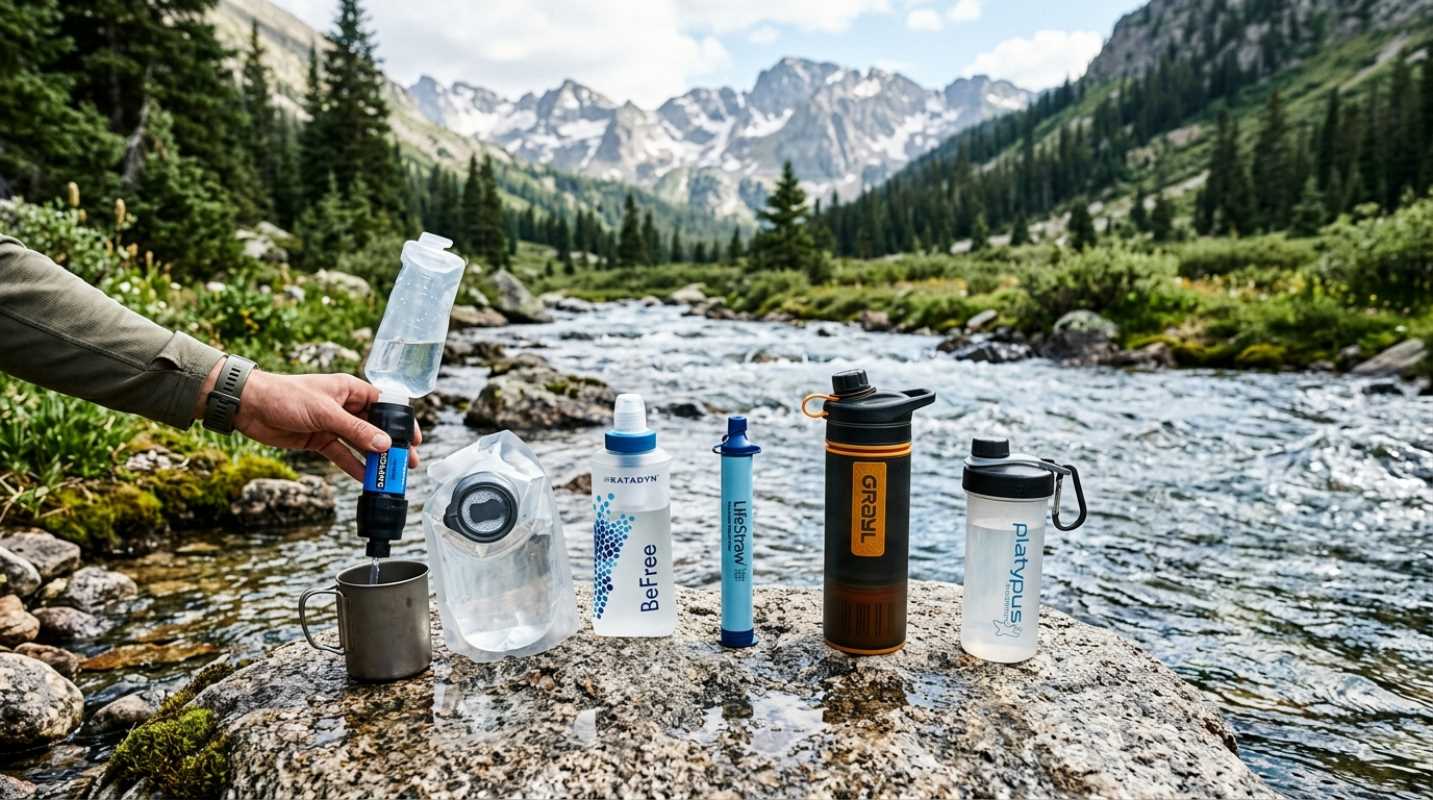
1. Sawyer Squeeze: This is the undisputed classic of the thru-hiking world.¹ Daily trail life is tough, but this filter is tougher. It weighs a mere 3.0 ounces and uses hollow fiber membrane technology with a 0.1-micron absolute pore size. This physical barrier stops 99.99999% of bacteria and 99.9999% of protozoa. It's backed by a lifetime warranty, meaning it can last for hundreds of thousands of liters if you take care of it. The only real downside is that the stock squeeze bags are prone to popping, so most hikers pair the filter with a more durable bottle or bladder.
2. Katadyn BeFree 1.0L: If you hate waiting for your water to filter, this is the speed champion.² It weighs only 2.3 ounces including the collapsible flask, and it flows at an incredible 2.0 liters per minute. You just scoop and squeeze. The flow rate is fast because of the wide-mouth design, which also makes scooping from shallow pools incredibly easy. But those hollow fibers are highly sensitive to muddy water and glacial silt. If you hike in silty areas, you'll need to clean it constantly to keep the water flowing.
3. Platypus QuickDraw: This clever system is a direct challenger to the Sawyer Squeeze.³ It weighs just 2.2 ounces for the filter and offers a blazing-fast flow rate of up to 3.0 liters per minute. What makes it special is the dual-thread design. You can screw it directly onto standard plastic water bottles or the proprietary Platypus wide-mouth reservoirs. It also features a clean-side cap to prevent dirty water from dripping onto your clean bottle, and it has an easy integrity check to see if the filter has been damaged by a hard drop or freezing temperatures.
4. Grayl UltraPress: This is a full-scale purifier, not just a filter.⁴ It's the ultimate choice if you're traveling internationally or hiking in areas with high human traffic. It uses electroadsorption and activated carbon to pull out 99.99% of viruses, along with heavy metals and chemicals. The French-press design is incredibly simple: you just fill the outer cup, press the inner cup down, and drink. It's heavy at 12.5 ounces, and the cartridge only lasts for 150 liters, but the peace of mind is unmatched.
5. LifeStraw Peak Squeeze 1.0L: Designed to address the durability issues of other squeeze systems, this tool is built like a tank.⁵ The soft flask is made of a thick, puncture-resistant material that handles rough trail use with ease. The filter weighs 3.8 ounces and is rated to last for 2,000 liters. It's highly versatile, allowing you to use it as a straw, a squeeze filter, or part of a gravity system. Just keep in mind that you need to carry the included syringe to backflush it, otherwise the flow rate drops off quickly.
Choosing the Right System for Your Trek
You should focus on finding the filter that matches your specific hiking style and environment, rather than searching for a single perfect option.
First, think about weight versus convenience. If you're a fastpacker or trail runner, every ounce matters. A featherweight system like the Katadyn BeFree will keep you moving fast without weighing you down. On the other hand, if you're planning a multi-week thru-hike, the long-term reliability and lifetime warranty of the Sawyer Squeeze are hard to beat.
Second, consider your water sources. Are you filtering from clear mountain springs, or muddy desert potholes? If you expect a lot of silt and debris, filters with larger pore sizes or those that are easy to backflush in the field are important. Silt will quickly clog a delicate filter, leaving you frustrated on the trail.
Finally, pay attention to the pathogens you need to target. Standard hollow-fiber filters have pore sizes between 0.1 and 0.2 microns. This is perfect for removing bacteria and protozoa like Giardia. But viruses are much smaller and will pass right through. If you're hiking in areas with poor sanitation or traveling abroad, you must use a purifier like the Grayl UltraPress to stay safe.
Pro Tips for Field Maintenance and Longevity
No matter which system you choose, a water filter is only as good as its maintenance. If you neglect your gear, you'll find yourself squeezing with all your might just to get a few drops of water.
Here are a few simple rules to keep your filter running smoothly
• Backflush early and often: Don't wait until your filter is completely clogged to clean it. Backflushing pushes clean water backward through the system to clear out trapped sediment. Doing this after every few days of hiking will keep your flow rate high.
• Protect it from freezing: Hollow fiber filters work by trapping water inside microscopic tubes. If that water freezes, it expands and breaks the internal fibers, rendering the filter useless. On cold nights, put your filter in a plastic bag and sleep with it inside your sleeping bag.
• Sanitize before long-term storage: Before you put your gear away for the winter, run a weak bleach solution through the filter. This kills any lingering bacteria and prevents mold from growing inside the housing while it sits in your closet.
Hydrate Confidently and Explore Further
At the end of the day, having a reliable water setup is what allows you to push deeper into the backcountry. When you don't have to worry about the safety of your water, you can focus on the beauty of the trail and the challenge of the climb.
Investing in high-quality filtration gear is an investment in your health and your peace of mind. Whether you choose the ultralight speed of a squeeze filter or the complete protection of a purifier, make sure you know how to use it and maintain it.
So, grab your pack, choose your filter, and head out into the wild. Safe, clean water is just a squeeze away.
Sources:
1. Sawyer Water Filters Review
https://twotrailbirds.com/sawyer-water-filters-review/
2. Best Backpacking Water Filters
https://bikehikesafari.com/best-backpacking-water-filters/
3. Best Backpacking Water Filter
https://www.outdoorgearlab.com/topics/camping-and-hiking/best-backpacking-water-filter
4. Best Water Filters for Backpacking, Camping, and Emergencies
https://www.outdoorlife.com/gear/best-water-filters-for-backpacking-camping-and-emergencies/
5. LifeStraw Peak Squeeze Review
https://www.cleverhiker.com/backpacking/lifestraw-peak-straw-review/